![]() Financial Daily from THE HINDU group of publications Monday, Dec 16, 2002 |
|
|
|
|
|
Logistics
-
Interview `Core infrastructure must improve' Mr S. K. Mohapatra, Chairman, Paradip Port Trust Santanu Sanyal
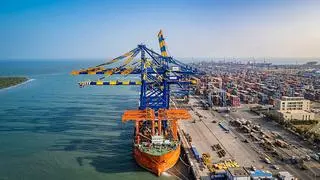
Mr S. K. Mohapatra, a 1976-batch IAS officer belonging to the Gujarat cadre, has completed a five-year term as the Chairman of Paradip Port Trust. It will be another four months or so before he moves on to his next assignment. His years in Paradip have been through many vicissitudes. The supercyclone of October 1999 dealt a severe blow to the port. But he handled all the crises deftly and put the port on a growth path. From virtually a single-commodity port, Paradip is emerging as a multi-commodity port. Mr Mohapatra spoke to Business Line on his experiences, the port and its future. Excerpts from the interview: You have completed the five-year term as Chairman of Paradip port. How will you describe your experience? Very eventful. Five years is a long time. During this period, we had many ups and downs. There was the super-cyclone of October 1999. Yet, during my tenure, the port's capacity tripled to 35 million tonnes (m.t.), the throughput doubled to 24 m.t., productivity measured in terms of output per day per berth improved significantly and the port posted significant growth in terms of other parameters such as turnaround time and pre-berthing detention of vessels. We have achieved 80 per cent mechanisation as for handling of bulk cargoes against 45 per cent previously, succeeded in adding more berths; there are now a total of 13 berths, with the 14th due for commissioning shortly, and completed projects worth Rs 1,000 crore. Of this, only Rs 480 crore was received as line of credit from the Asian Development Bank to part fund the mechanised coal handling facility, and the rest was generated internally. For the first time in 12 years, we have repaid government loans of about Rs 70 crore. In other words, financially too we are in a comfort zone. Your mechanised the coal handling facility... When I came to Paradip five years ago, there were apprehensions about the project. There had been delays and consequent cost escalations due to various reasons. Many of us were not sure if the Australian technology (you know, BHP-Kinhill of Australia was consultant to the project would work. Not all the apprehensions were unfounded. BOBR (bottom-open bottom-release) wagons were a new concept and initially we took a lot of time to complete the unloading of one rake. Then there were difficult issues to resolve, such as the fixing of tariffs and redeployment of pool workers about 1,500 of them. We had so many other problems. It would be rash to claim that all the problems are over yet but we are certainly much better placed now than before. You said not all the problems are over yet. Could you please elaborate? The biggest challenge facing the port authorities today is how to generate enough traffic for the mechanised coal handling plant built at such a huge investment. For various reasons, the current throughput of the thermal coal traffic is not satisfactory. True, we have succeeded in booking profits even at the present level of throughput but that is not all. Since the prospect of thermal coal traffic does not appear to be too bright, we are planning to modify the plant to handle iron ore there, more so because the ore traffic at the port is poised for a big leap. Do you have any regrets? My only regret is that I wanted to have two more berths constructed one for the clean cargo particularly foodgrains and containers on the southern side and a deep draft berth for handling coking coal import and iron ore export, each of one million tonne per annum capacity. The clean cargo berth need not handle big ships but on an average 40,000 DWT capacity vessels. For deep draft berth, we have to have a depth of 15 metres to achieve a draft of about 17 metres for handling capesize vessels up to 120,000 DWT capacity. Once we have the deep-draft berth, certain types of vessels, which cannot come to the port, now will be able to call here. Unfortunately, my dream will remain unfulfilled as my term at Paradip will be over March 31, 2003. Do you think, the port will need more berths? No, I do not think so. After these two berths that is, the clean cargo berth and the deep draft berth have been constructed, there will be no need for any more, at least for some more years to come. Instead of constructing more berths, the port should now concentre on strengthening the core infrastructure like maintenance of proper depth of the channel, constructing longer breakwaters. We do not have a channel with 13.5-metre depth which is needed. We have placed before the government a Rs 100-crore scheme for deepening of the harbour and widening of the channel and we hope the scheme will be cleared by the Centre for implementation during the Tenth Plan. The widening of the channel is particularly needed because Paradip will be required to handle crude traffic in a big way in the not-too-distant future. The oil jetty due for commissioning soon will start handling transhipment crude shortly while the installation of SBM (single buoy mooring) to facilitate the handling of crude for Indian Oil Corporation's proposed 12-MTPA capacity refinery will enable the port handle large volumes of crude traffic. Which means the port's cargo profile is set for a change. Isn't it? Paradip must broadbase its cargo portfolio. A beginning has been made. We've started handling containers, presently on a limited scale but we are sure to achieve a breakthrough in due course. We have announced a plethora of concessions to attract container traffic. We are trying to persuade recalcitrant shipping lines to change their stand and offer services from Paradip. I am confident all these efforts will yield results. We have also started handling import of raw sugar. The commissioning of the Cargill's edible oil refinery within a year or so will boost the edible oil traffic and we have invited applications from entrepreneurs for setting up wood-based units near the port as the prospect of log imports from Malaysia appears to be bright. In today's competitive world, it is dangerous to depend too much on one or two types of cargo.
Send this article to Friends by
E-Mail
|
Stories in this Section |
|
The Hindu Group: Home | About Us | Copyright | Archives | Contacts | Subscription Group Sites: The Hindu | Business Line | The Sportstar | Frontline | Home |
Copyright © 2002, The
Hindu Business Line. Republication or redissemination of the contents of
this screen are expressly prohibited without the written consent of
The Hindu Business Line
|