![]() Financial Daily from THE HINDU group of publications Thursday, Feb 10, 2005 |
|
|
|
|
|
Industry & Economy
-
Exports & Imports Govt hopeful of meeting export targets G. Srinivasan
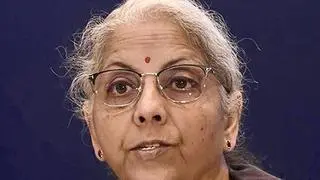
The Commerce Secretary, Mr S.N. Menon
New Delhi , Feb. 9 CLOSE on the heels of the advance estimates putting the gross domestic product (GDP) growth at 6.9 per cent for the current fiscal, the Government is bullish on the export front, presumably because of two positive factors - overall sound economic growth in general and manufacturing growth in particular. In his first-ever formal interview after he was appointed as Commerce Secretary in October 2004, Mr S.N. Menon told Business Line here that "the manufacturing growth is on the upswing, as a result of which the export target originally, fixed at 16 per cent in dollar terms, should be well above 16 per cent by the end of the current fiscal". In fact, during the first three quarters of the current fiscal exports notched up a growth of over 23 per cent, though December 2004 was a bit difficult month mainly because in the textile and clothing sector shipment to the US did not take place in the run-up to the expiry of quota regime as there was some fear that shipment before December 31, 2004 would have had problems. But since the end of December 2004, this perception had changed and "this is the report I am getting informally from the ports," Mr Menon added. Elaborating on export prospects, the Commerce Secretary said that "the fundamental objective, if we have to sustain this high level of growth, is not so much giving incentives to the exporters but to remove the procedural bottlenecks. These include, neutralisation of the actual cost of duties, levies and taxes and improving the procedures as also the issue of trade facilitation by which one should be in a position to reduce the transaction cost to a substantial extent." He, however, said, "Certain kind of infrastructural costs would be there which includes energy cost as also communication costs - that of rail, road and containers which have to be made competitive and we have to continuously put pressure through regulation to reduce them." Pointing out that more than giving benefits to exporters what they really want is "a fair playing field", Mr Menon said that this includes less harassment and transparent system of operations "which is what our objectives are and which is what I believe all our objectives in the Government should be". He said that if the economy and exports are growing substantially along with a healthy growth in imports it implies that manufacturing and investment activities are picking up and all that the Government needs is to enable the present level of growth to sustain and try to capitalise on it. "Fundamentally it means coordination at different levels of government on procedures," Mr Menon said. Asked about whether this line of thinking would get reflected in the forthcoming modification to the foreign trade policy to be unveiled on March 31, 2005, Mr Menon noted, "We are working on this issue and trying to put things together. We are in the mode of listening to people and understanding what the problems are for the new foreign trade policy." He said, "we are in the process of looking at the Duty Entitlement Passbook Scheme to neutralise customs duty paid on inputs in a holistic manner. The recent revision in drawback rates has raised some issues for textiles and leather sectors. But there is a need to evolve a system that really neutralises duties, levies and costs to exporters." He said that if the WTO allows neutralisation of duties, levies and taxes, "we should develop a methodology to see that in a transparent manner this is done as DEPB and drawback rates play a definitive role which support exports". On the Central legislation for Special Economic Zone (SEZs), Mr Menon said that "SEZ bill is vital to us and I do expect that the system within the country will support us. The new SEZ concept is State-driven and not Centre-driven. It is support between State and private sector partner in which the Centre acts as a facilitator and all the States are interested in this Bill as they realise how important it is for development of infrastructure and investment. We do believe that the legislation will be pushed through the common will of the people in the State and their elected representatives."
Article E-Mail :: Comment :: Syndication :: Printer Friendly Page
|
Stories in this Section |
|
The Hindu Group: Home | About Us | Copyright | Archives | Contacts | Subscription Group Sites: The Hindu | Business Line | The Sportstar | Frontline | The Hindu eBooks | The Hindu Images | Home |
Copyright © 2005, The
Hindu Business Line. Republication or redissemination of the contents of
this screen are expressly prohibited without the written consent of
The Hindu Business Line
|