![]() Financial Daily from THE HINDU group of publications Monday, Jul 25, 2005 |
|
|
|
|
|
Opinion
-
Education Columns - Vision 2020 Research universities: Mind is the key P. V. Indiresan
Resistance to quality education comes primarily from politically powerful backward castes. The success of Navodaya Schools is proof enough that there are many intrinsically competent children in poor communities but they suffer from two handicaps: (a) they do not get to attend good schools and (b) the domestic environment does not inspire them to study hard. The erstwhile British 11-plus scheme could be an effective remedy. In that system, at age 11 (not standard 11) promising children were identified by a nationwide examination and admitted to well-endowed "grammar" schools. In India, it would be better to hold such tests district-wise. That will minimise the handicap children from small towns and villages may suffer in a nationwide selection. For several reasons, selection at age 11 is about the best. One, it prevents rich children from getting undue advantage by getting private coaching over long years. Two, it is early enough for poor families to sense the benefit of educating children, and thereby, induce them to send their children to school. Three, competing at that age requires five years of study. That indicates the child had parental support an essential condition for children to perform well. Four, with this scheme, higher education will have a larger pool of competent students to choose from.
Caste-based reservation at 11 years causes comparatively less harm because there is much more time to remedy ills of backwardness than when reservation operates at the college level. Early selection will also give better chance to the poor to rise; now, the poor have little hope of succeeding against competition from upper-middle class families of their own caste. The country has barely a hundred thousand top positions in all professions to be filled in any year. Hence, it is enough to support that many each year, or 700,000 bright children in all (from Class VI to XII). That will cost around Rs 2,000 crore a year. For several reasons, it would be in the self-interest of private industry to bear that cost and not leave it to State governments. One, when poor, bright children get quality education, private industry will have a larger pool of talent to choose from. Two, once a well-trained cohort of backward castes becomes available, there will be little need to lower academic standards to meet political pressures. Three, private industry is under enormous pressure to introduce caste-based reservation; this scheme can become proof of private sector's commitment to social justice and a low-cost insurance against political interference. The cost is less than 0.1 per cent of the value private industry adds every year, and much less than what it spends on publicity. It is not enough for private industry to finance school education for bright students from backward castes; it should also invest in research and development. Fortunately, after long years of indifference, Indian industry is waking up to the importance of R&D. In particular, MNCs are heavily investing in research laboratories in India. Hence, careers in research will become quite attractive; the pool of research talent will grow and reach the critical mass needed for high quality work. The Central Government has been financially generous to the IITs and the IISc but, administratively, constrictive. The Human Resource Development Ministry still suffers from the virus of Licence Raj. Just as it was a criminal offence to produce more than what the industry was licensed to produce, it is the rule that IITs should not attract endowments in excess of Rs 100 crore. The Ministry has no problem with institutions that fail to attract endowments; it gets alarmed only when any institution becomes successful. Hopefully, the Ministry will realise the folly of setting caps on success. Looking at the way private schools and colleges have moved to the forefront of quality education, we should expect private institutions to take the lead in research universities too. In recent years, the Department of Science and Technology has been operating a very attractive scheme of funding development-oriented Master level courses in engineering. So far, only private colleges have shown the initiative to take advantage of the scheme and no government college (not even any National Institute of Technology) has done so. That is an indicator that, unless government policies change, future lies with private institutions and not with government colleges. In-breeding is a national malaise, and the IITs and the IISc are not free from it. Internationally reputed faculty gave these institutions a glamorous start; over a period such talent has faded. Outstanding academics are like hybrid seed; they do not regenerate well. American universities have remained at the top only because they make irresistible offers to attract great minds from outside. India too should do the same by launching special professorships with endowments of at least Rs 1 crore a year, about the minimum to attract scholars of world renown. Money is not enough: Great minds need administrative freedom too including the freedom to fix salaries, to operate funds without interference from unimaginative babus of the CAG's office. Any IIT which can attract a score of such glamorous professors (costing no more than Rs. 20 crore a year) should be able to launch world-class research and attract many bright students who now prefer to sell soap for want of glamorous guides. No matter how much the management of universities is liberalised and allowed to improve, little benefit will accrue if we continue with the present craze for nationwide entrance examinations. Entrance examinations have their uses but they cannot be the absolute arbiters of competence, the way they are in India. Great universities use multiple criteria for admissions school grades, common tests such as SAT and face-to-face interview. We too should do the same. Entrance examinations came to the fore because school boards started inflating marks. We can avoid that risk if results are given in the form of percentile ranks and not by absolute marks. Next, candidates may be shortlisted on the basis of their combined school and entrance examinations score, but the number so shortlisted need not be more than 50 or 100 per cent higher than the numbers to be admitted. This relatively small shortlist of applicants may then be intensively examined to estimate the ability of the students to think rather than regurgitate model answers to typical questions. This extra step is important also because copying and frauds vitiate large-scale examinations, and their results are not reliable. India can build world-class research universities. The country has brilliant motivated students. It can attract world-class faculty. Danger comes from hypocritical politicians and "intellectual" busybodies who preach that it is a moral duty to prop up the incompetent and that high ability must be, somehow or other, unethical. Traditionally, teachers are known as masters, bureaucrats as servants. A teacher is a master all his life but a bureaucrat is not even a servant after vacating the chair. Only teachers can build great universities and not any government office. We need a government that accepts that reality and treats teachers with respect and not as servants the way it does now. (Concluded)
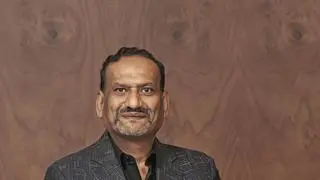
(The author is a former Director of IIT Madras. Response may be sent to indresan@vsnl.com) (This is 154th in the Vision 2020 series. The previous article was published on July 11.)
Article E-Mail :: Comment :: Syndication :: Printer Friendly Page
|
Stories in this Section |
|
The Hindu Group: Home | About Us | Copyright | Archives | Contacts | Subscription Group Sites: The Hindu | Business Line | The Sportstar | Frontline | The Hindu eBooks | The Hindu Images | Home |
Copyright © 2005, The
Hindu Business Line. Republication or redissemination of the contents of
this screen are expressly prohibited without the written consent of
The Hindu Business Line
|