Business Daily from THE HINDU group of publications Wednesday, Nov 19, 2008 ePaper | Mobile/PDA Version | Audio | Blogs |
|
|
|
|
|
Opinion
-
Economy Columns - Down to Earth No! Not back to socialism! Markets are live organisms and not mechanical contraptions. They work like birds. All birds have to move their wings up and down in order to gain height. Even the strongest of birds has to come down and take some rest on a branch from time to time.
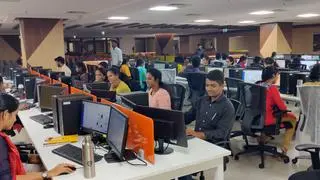
Jet Airways employees just after the retrenchment announcement… Social problems created by the recession should be taken care of by social safety nets, unemployment insurance and acceptance of uniform reduction in salaries. Sharad Joshi Two events that occurred in the last month may influence the future of Indian polity and economics far more than one can imagine. Mr Ratan Tata wrote an open letter to the people of West Bengal, particularly to the youth there, appealing to them to think whether they wished to support the progressive economic policies of the State’s CPM Government or lend support to the obstructive agitation politics of the likes of Ms Mamata Banerjee that would cause a repetition of the exodus of industry from West Bengal, as happened 30 years back. Mr Tata, obviously, has forgotten that it was the agitation tactics of the present Chief Minister’s party that had resulted in the exodus of industry from West Bengal three decades ago. Despite this, the head of one of the most respected industrial groups in the country has tried to influence public opinion in favour of one party and against the other. In a second event, it was a political party that influenced the decisions of a private aviation company. The Jet Airways Chairman, Mr Naresh Goyal, capitulated meekly and reversed the decision to lay off some 1,900 of the airline’s staff, taken barely 24 hours earlier. The reversal came so soon after the issuance of a threat by Raj Thackeray that it left no doubt in anybody’s mind that Naresh Goyal had succumbed to the blackmail of the Maharashtra Navnirman Sena (MNS). In the Singur case, the Tatas were seriously concerned about the safety of their staff facing the agitation that had clearly gone beyond the control of the State government. In the case of Jet Airways, Naresh Goyal’s assertion that “the staff of Jet Airways were like members of his family” seemed exaggerated. If Mr Goyal had entertained this lofty sentiment 24 hours earlier, when he decided on retrenchment, the crisis would not have arisen at all. Something had obviously made him change his mind. In a rather amusing comical scenario, various parties including MNS’s parent Shiv Sena as also the Civil Aviation Minister himself vied with each other to claim credit for Naresh Goyal’s volte face“Chi Chi”. RetrenchmentIt cannot be ruled out that Mr Goyal created a political situation that would corner the Finance Minister and the Civil Aviation Minister by creating a labour imbroglio with a view to securing a reduction in taxes on aviation fuel. If that was Mr Goyal’s strategy, it certainly worked. The major beneficiary was, of course, Marathi parochialism. The event underlined the sensitive character of the issue of labour retrenchment. Retrenchment and unemployment hurt those directly affected, of course, but even more so the politicians with populist planks. Already, a number of columnists have started expressing their doubts whether Nehruvian socialism was not a better option than Dr Manmohan Singh’s liberalisation and globalisation. It’s funny how so many economists who spent a lifetime building socialist theories and institutions switched over to economic reforms soon after 1991. We will possibly witness a reverse flow towards socialism in the days to come. Systems based on the predominance of public sector institutions that generally have an employment orientation, are once again finding their defenders and champions. Politicians, as a species, view retrenchment as a certain vote-snatcher. At the very first signs of economic recession and retrenchment, politicians and economists appear flabbergasted enough to beat a hasty retreat towards the illusion of a safer and more comfortable welfare/socialist regime. These neo-socialists appear to lose sight of the fact that India faced large-scale secular unemployment during the epoch of socialism. The governments of the era concealed the massive unemployment by giving figures of employment created in the public sector rather than publishing the figures of those who remained unemployed. Politicians and economists appear to prefer secular massive unemployment to temporary retrenchment here and there, now and then. Markets are live organisms and not mechanical contraptions. They work like birds. The birds have to move their wings up and down in order to gain height. Even the strongest of the birds has to come down and take rest on a branch from time to time. That does not make the birds inferior to insects and reptiles. Retrenchment is, of course, painful and undesirable and should be, in principle, the last option to be exercised by the employers. Mr Naresh Goyal of Jet Airways rendered his fraternity a signal disservice by rushing into an ill-thought-out mass retrenchment and reversing the decision with even less thought. The economic plight of the company could have been easily explained to the representatives of the staff. They could have been convinced that temporary retrenchment was in the interest of the staff as also of the company. The only alternative would be acceptance by the Unions of reduction in salaries and perks that would, more or less, keep the total company wage bill constant. After all, trade unions work on the principle of collective bargaining. Collective bargaining does not mean only negotiating for hikes in wages and perks in days of prosperity, when the things are going well for the company. It also means collectively finding ways out of economic difficulties. The staff could have been easily persuaded to accept a pro-rata reduction in the salaries and perks to avoid a certain number of them being sent home. Market-oriented systemLet no one forget that the socialist welfare state spelt secular stagnation for all the years since Independence. A market-oriented system might have its ups and downs. That is inevitable in any free moving body — economic, social or aerodynamic. The social problems created by the recession should be taken care of by social safety nets, unemployment insurance and acceptance of uniform reduction in salaries and perks. It would be most unfortunate if the economists tried to frighten the people back to the days of the license-permit-quota-inspector raj, where no one was allowed to do anything; but nothing was disallowed to those with the necessary political pull. India lost over four decades experimenting with a system that has lost all credibility. Let us hope we have avoided a second bout of the same disease. Surprisingly, I found it easier to explain this phenomenon to an audience of semi-literate and illiterate farmers. The audience understood that leaf shedding is a part of the growth of any tree. All living organisms have their ups and downs. A mother would not exchange her baby for a doll simply because the doll does not fall ill. The last 20 years have given the people a taste of near double-digit rates of growth. They would not settle for the old Hindu rate of 3 per cent for another 50 years, merely because the markets have their swings. More Stories on : Economy | Industrial Policy | Down to Earth
Article E-Mail :: Comment :: Syndication :: Printer Friendly Page
|
|
The Hindu Group: Home | About Us | Copyright | Archives | Contacts | Subscription Group Sites: The Hindu | The Hindu ePaper | Business Line | Business Line ePaper | Sportstar | Frontline | The Hindu eBooks | The Hindu Images | Home |
Copyright © 2008, The
Hindu Business Line. Republication or redissemination of the contents of
this screen are expressly prohibited without the written consent of
The Hindu Business Line
|