Financial Daily from THE HINDU group of publications
Saturday, Mar 26, 2005

Canvas
Features
Stocks
Port Info
Archives

Group Sites

Canvas - Human Resources
Industry & Economy - Education


A special calling

Priyanka Jayashankar

Creative thinking and offbeat choices... that's the career in the world of alternative education and special education.

An animated Anandhi recounts how her students had built a tunnel in the sand pit and let water run through it. Likening them with budding scientists, she asks, "You think reading any science text can build these faculties in children?"

As an alternative educator at Abhaya, a Waldorf school in Hyderabad, Anandhi enthuses tiny tots with rhythmic recitation, music and handwork. Besides all these techniques, "a teacher needs creativity and intelligent thinking," she says.

But can such careers draw youngsters tempted by the riches of the corporate world? Surprisingly, some have managed to cross over from the much trodden IIT-MBA route to alternative teaching.

Take for instance, S. Arun, an engineer-turned teacher. "I was appalled by industrial pollution and wanted to pursue my passion for the environment," he recalls. Now, he divides his time between organic farming and environmental teaching at KFI School, Chennai. Doing away with `chalk-and-talk' techniques, Arun conducts self-study courses, outdoor walks and even trips to tribal areas.

He swears by Howard Gardner's multiple-intelligence theory, where a child is evaluated for different kinds of intelligence (like kinaesthetic, mathematical, spatial and linguistic). "Many students want a less exam-oriented system."

There have been other engineers too, like Arun, who have quit the rat race and now teach at KFI. With multicoloured classrooms and animal statues perched on lush lawns, Chennai's Vaels Billabong High has made a headstart in offbeat pedagogy. As part of environmental science homework, children are asked to watch TV commercials to spot herbal products! Without getting bogged down to exams, they get to visit recording studios or discuss career prospects with musicians and even sailors, among others.

"We want teachers who are open to new ideas and who can get down to the child's level," says the Principal, K.R. Maalathi. Alluding to the rising number of applications for teaching jobs, she adds, "Several professionals, especially those in call centres/ BPOs, are keen on pursuing teaching, which is a creative profession with better timings." Educators from Dubai and Malaysia, as well as experts in music, dance and theatre, have been recruited.

In collaboration with Billanook College, Australia, the school offers a mix of mainstream and Montessori teaching at the play-school level. Optimistic about the growth of alternative education in India, Maalathi says many nuclear families are keen to enrol their children into schools that can enhance personality development.

"In a knowledge-based society, parents are willing to invest more in their children's education right from kindergarten," says Maya Menon, Director of Teacher Foundation, an organisation that trains mainstream and alternative educators. Owing to the growth of international and niche private schools in Bangalore, alternative education is in greater demand, she adds.

Leaving behind a career in the print media, Divya is gung-ho about her course in Montessori education. The 20-something was drawn by the system's child-friendly syllabus. Free from the shackles of a regular classroom, Montessori kids learn life skills at their own pace. Montessori teachers encourage group activity and handwork, and they never hush up talkative toddlers. "Mainstream educators don't realise that children have a great urge to learn languages until the age of six," Divya rues. She also observes that many young professionals are keen to join this stream.

The special educators

Sudha Ramamoorthy, Principal of Vidya Sagar, a Chennai-based school for children with special needs, says many people from different professional backgrounds are now opting for special education.

After a stint in the IT sector, Sunitha Narayan became a special educator. "I felt very strongly that it was my calling in life," says Sunitha, who now teaches at an inner city school (for underprivileged children from ghetto areas) in Cleveland, US.

Having taught children with cerebral palsy, learning disabilities and autism for several years, she cautions that the job can be physically and emotionally taxing. "Burnout rates are very high. You are acting as a guide, teacher, friend, counsellor, therapist and confidant — all rolled into one."

Anuradha Shyam, a counsellor for children with learning disabilities, explains that many young special educators have called it quits due to the low pay as well as the physical exertion. "However, if they remain patient and chart out a career path, special education can be creatively and financially rewarding." In fact, a professional body (on the lines of ICAI for accountants) can help special educators improve their teaching techniques, she adds.

"Special education must be valued rather than considered merely as a social service," opines Sadiya Saleh, Human Resource Development Co-ordinator at Vidya Sagar. Several special schools across the country, in fact, now offer better salaries. Special educators are also sought after because of the integration of disabled children into mainstream schools. Since disability has evolved as a human rights issue from a medical issue, "doctors see these educators as their counterpart," says Sudha.

A growing number of physiotherapists and speech therapists are foraying into special education. After a physiotherapy degree, Fabian David Jude has taken up a project on sensory integration for autistic children in the US. "Special education can help physiotherapists work in areas like academics, speech, occupational rehabilitation, leisure, psychological problems and not merely motor rehabilitation," he says.

Madhi, a physiotherapist and special educator at Vidya Sagar, beams as she describes how she uses dance and drama to help special children overcome problems related to depth perception. "Physiotherapists must conduct workshops for disabled children. They also have to get sensitised to children with cerebral palsy," she stresses.

Special schools in India, as well as public and private schools in the US, are recruiting trans-disciplinary therapists (trained to handle multiple disabilities). Occupational therapy to develop a special child's life skills is also a burgeoning career option. "An occupational therapist makes a special child independent through a life span. This entails daily activities, academics and leisure," explains Sadiya.

Even technologists have been drawn to special education. BITS Pilani graduate Deepa Bharath heard an awe-inspiring lecture on disability. Since then, she has successfully customised software and hardware for children with multiple disabilities. "Software companies must have a non-profit research team to design and implement software for people with disabilities," says Deepa, who works as a kindergarten teacher in New York.

While US universities offer special education courses that help Indian educators hone their skills, all is not hunky-dory on the job front. Deepa warns that recruitment agencies mislead Asian special educators. "Many teachers sign a bond with the agencies and find themselves in challenging settings where life is hard for American teachers themselves and even more so for new, non-native teachers," she says.

Life at a US inner city school is a far cry from the American dream for Sunitha. She has come across trigger-happy sixth graders, drug abuse and urban poverty. "But amidst all this you do see hope and that's what keeps you moving forward. It's so easy to focus on the negatives, yet it would make so much more sense when you see the kids graduate," she says optimistically.

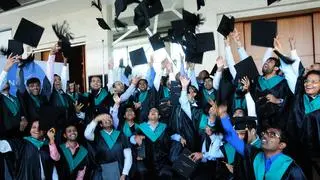
Picture by Bijoy Ghosh

Article E-Mail :: Comment :: Syndication :: Printer Friendly Page

Stories in this Section
The new-look HR guy


The importance of being in HR
A special calling
Are you game?
The outdoor zealots
What's in fashion...
That's the take
Let's talk... music!


The Hindu Group: Home | About Us | Copyright | Archives | Contacts | Subscription
Group Sites: The Hindu | Business Line | The Sportstar | Frontline | The Hindu eBooks | The Hindu Images | Home |

Copyright © 2005, The Hindu Business Line. Republication or redissemination of the contents of this screen are expressly prohibited without the written consent of The Hindu Business Line