Business Daily from THE HINDU group of publications Monday, Mar 30, 2009 ePaper | Mobile/PDA Version | Audio | Blogs |
|
|
|
|
|
eWorld
-
Interview '800 million waiting to be connected'
“CDMA gives us a clear advantage — for the same amount of capex we can do more coverage. Also, quality of the network is better.”
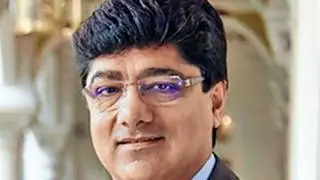
Vsevold Rozanov M. Ramesh Vsevold Rozanov, the 37-year-old President and CEO of Sistema Shyam TeleServices Ltd, believes that he has a “joyful” task on his hands — in contrast with other telecom company heads around the world, who have to grapple with cost and manpower cutting. Sitting at the helm at a time when Sistema Shyam is beginning national rollout of its mobile telephony services, Rozanov says he derives pleasure out of “creating something”. Sistema has invested $2 billion in India, and expects to spend another $3.5 billion over the next five years. In an interview to eWorld, he explains why the Russian telecom major is willing to take a $5.5-billion bet on India. Excerpts from the chat: You have said that CDMA is your preferred technology. Yet you are seeking GSM licence. Why? Currently, the strategy is to go with CDMA. We do not look for GSM. What is true is that we have GSM licence. It is a very old GSM licence (that came to us) due to historical reasons. Now there is a certain agreement with Bharti Airtel that we cannot use GMS licence until May this year. From May, we have the right to provide GSM services in Rajasthan. But you don’t intend to exercise the right? At this stage, we are not doing this. However, for me it will be interesting to see how we can utilise it. Could you please amplify on that statement? For the time being, there is no any plan or discussion around GSM, which means that we are not going to announce anything or launch anything in May. At this stage, we are fully focussed on CDMA. I would like to look at whether it is possible to do business around GSM. Why CDMA now, especially in the India context of big players talking about moving over to GSM? This (CDMA) is a much more superior network and comes with much lower cost. In all markets outside India CDMA is a premium product. In Russia you have to pay a lot of money to get CDMA (licence). In India, for certain reasons that our policy does not allow me to tell you, the image of CDMA has been spoiled a little bit. Actually, the technology itself is becoming better and better. We are using the most modern technology which uses distributed base stations which gives us 20 per cent more coverage than the regular CDMA base stations. Especially, the spectrum available in GSM is 1800 — you know, to provide the same coverage the current GSM 1800 MHz technology would require 2.5-3 times more tower station capacity. CDMA gives us a clear advantage — for the same amount of capex we can do more coverage. Also, quality of the network is better. You are investing a huge amount of money in a market where there are already a number of well-entrenched players. Isn’t it a risky bet? Our confidence (in the Indian market) is based on macro economic parameters. The penetration is very low in India. And we clearly see that competitors who have scale have very good margins — margins many European players would be jealous of. That gives a clear view that it is important to get scale. When you have very low penetration, there is a reasonable chance that we can acquire scale to break even and start making good margins. In developed and developing countries mobile becomes absolutely necessary. It is not luxury goods. One may cut his budget but will still use the mobile phone. It’s like bread or rice for us. As people use it more, they cannot do away with that. From that sense, I would say that the current level of SIM penetration is 33 per cent, is very low. You know better than me that many customers use two or three SIM cards, so the actual penetration could be as low as 22-25 per cent. That means there are 700 million to 800 million people who are not connected. What would be your differentiation? Price? Definitely price would be one of the differentiators. ‘Value for money’ would be our key offer. But also, again, value for money comes from good network, comes with better customer service. Are you planning to introduce ‘value added services’? At this stage most of this is under development. We are in discussion with leading global and Indian companies to go into the various partnerships — revenue sharing-based and cost-based partnerships. We offer top notch network and they can provide something which might be interesting to various segments of customers. Targeting which segment? I think as we are fully a pre-paid, it will be more for individuals at the moment. We will look at corporate customers later, but at this stage, we are mostly focussed on the individuals. The dilemma we are facing is, whether or not to wait until we have the full range of services to launch. But we chose to launch now. We have a very good network from our perspective, especially for someone who has just launched. We can use this opportunity to generate customers. Why did Sistema take such a long time to come to India? That was because there were restrictions on FDI investments (in India’s telecom sector). Sistema has a policy of having at least 51 per cent. The policy changed only a few years ago. But definitely, for over the last six years, our Chairman was keenly looking at India. Considering the time you’ve taken, would you grow again through acquisitions? Frankly speaking, at this stage we are fully focussed on organic development. There are not that many targets left for us. Anyway, we will not be able to get scale without organic growth. For the MTS brand, does the Indian company have to pay royalty to MTS? Yes, but it is a very negligible amount. Do you plan to come into other areas of telecommunications such as undersea cabling, broadband…? No. Of course we have a lot of experience in doing mobility business in Russia and other countries. At this stage, mobility business is the key focus. Then there are some other opportunities appearing from time to time…tower infrastructure business, video conferencing, development of the fixed business, rolling out national fibre network…these kinds of things are in the air. But currently Sistema is fully focussed on mobile communications. We believe the sooner we go to the market, the stronger position we have in the long run. It is important for us to use our strengths — technical and financial — to do the network rollout and launch business as soon as possible because there are more guys coming into the market and there would be tougher competition in a year or a year-and-a-half. Russian Govt may pick up 20% stake in Sistema Shyam Sistema eyes more buys in India More Stories on : Interview | Telecommunications
Article E-Mail :: Comment :: Syndication :: Printer Friendly Page
|
|
The Hindu Group: Home | About Us | Copyright | Archives | Contacts | Subscription Group Sites: The Hindu | The Hindu ePaper | Business Line | Business Line ePaper | Sportstar | Frontline | The Hindu eBooks | The Hindu Images | Home |
Copyright © 2009, The
Hindu Business Line. Republication or redissemination of the contents of
this screen are expressly prohibited without the written consent of
The Hindu Business Line
|