Financial Daily from THE HINDU group of publications Monday, May 08, 2006 |
|
|
|
|
|
|
|
Mentor
-
Insight Columns - Swati CA Perfect marriage between professional skills and IT
Story so far: Trudging through traffic snarls caused by feverish electioneering, I wonder if democracy was after all, a question of averages that survived despite all jugglery and rhetoric. Watching a TV news reporter ask poll survey questions to a labourer, I ask myself if elections had any relevance for the poor? Episode 127
Do surveys ever manage to get a feel of the public's pulse? That was the question I was losing my sleep over, last week. In response, S. Gnana Haran writes, "Dear columnist, if you go by past records, I think opinion surveys do manage to get the pulse of the people." Reassuring, that is, though surveys can confuse many, especially when results are too varying. "With regard to the other issue, i.e., do elections matter to the poor and are they relevant to them, my answer is both yes and no," says Gnana. "Yes, because the freebies and, much before that, the money they get does matter. And `no' because they don't change their life beyond that." Interesting analysis. "Opinion surveys do capture their pulse and it's not that difficult to achieve that. If you really look at the Indian vote bank, it can be sliced broadly into two segments, i.e., the committed segment and the uncommitted segment. The committed segment, in turn, consists of two broad categories each favouring one particular alliance group. Within this group, there would be a segment, which is subject to swing factor. Such a swing may happen due to caste affiliation of the voters, freebies given etc." What about the uncommitted segment? "It basically consists of those who are not committed to voting at all," opines Gnana. "Here again, there would be a segment which would cross over to the committed segment and the triggers may come in some form other. Freebies play a very important role here, because of the socio-economic profile of the committed group. That is why parties are vying with one another in announcing freebies." The political economics of freebies! "One area that offers enormous scope for research is how people shift loyalties in the committed group and equally important is in finding out what would make the uncommitted group into a committed one," concludes Gnana. I'm sure that such a research would be useful for the contestants. "Dear Swati, elections are when one can hear all kinds of promises being made," writes Priya from Phoenix, after a long time! "Maybe we should do a `variance analysis' at the end of the period, between promises given and the end result," she suggests. "We are a tolerant lot and the poor are even more tolerant. The public would be a happier lot if the basic infrastructure were taken care of very well by the government." Priya feels that we need good roads, not just in the heart of the city but everywhere! She insists on good maintenance in schools (both rural and urban) all through the year, and the provision of proper sanitation facilities. "Instead of promising freebies to poor, incentives can be given to them for the work done." What about surveys? "Instead of asking whom they will vote for, it can be made more informative by surveying the progress made in various fields. Let's hope the leaders understand the difficulties faced by the middle class and the poor and work towards lessening them." May these not be fond hopes! "Rarely do we find voter turnouts exceeding 75 per cent in elections," laments Soni Achuthan, Haripad, Alleppey. "The labourer might have participated in the pre-poll survey. But will he vote in the elections? In many belts, most of the residents are loyal only to a particular political party. Such belts may not be considered at all in a pre-poll," adds Soni.
Legal process outsourcing
I have read how LPO or legal process outsourcing is becoming popular. At one time, we spoke only about BPO (business process outsourcing), and about how cost advantages have driven, from abroad towards Indian shores, routine work such as enquiry handling. A similar shift is happening with legal work too. During a recent seminar, Dorothy Thomas of Kochhar & Co had explained that preparation of pleadings, docketing, proof-reading, transcription of recorded documents, litigation support and research, case studies and law firm marketing are various avenues of work that are being outsourced to India. A fellow chartered accountant sitting next to me had asked Dorothy if the avenues she spoke of would be open to professional accountants too. Heartening, it was, for the audience to hear an affirmative response. "Outsourcing legal work to India costs up to 80 per cent less than the cost of using the services of American law firms," she explained through a slide. "Hourly rates charged by Indian LPOs range between $40 and $60, while the same work performed in the US would cost a whopping $350! The average salary of an attorney working at an outsourcing centre is around Rs 25,000." Indian attorneys with US/UK qualifications are much in demand said Dorothy. "International attorneys are impressed not only by the labour cost differential, but also by the quality and speed of work done."
Law by wire!
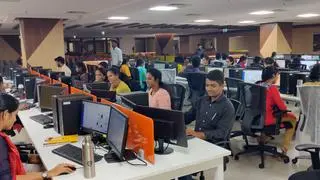
Last week, I was strolling around in Chennai Citi Centre when I bumped into my old friend Jambunath (whom we use to call Jumbo, owing to his size!) and the first thing I said was, "Hey, you've slimmed down!" He chuckled and said, "Yeah, lot of work." I remembered he chose law after our college days, and then went on to work as a junior in a law firm. "Still a junior, Jumbo... er.. Jambu?" I asked him. "No, Swati, I'm on my own. Running an LPO! It's called NiyamPal." Wow, that was just the thing I wanted to visit, I said. "Okay, make it at 8 pm tomorrow. But no spying!" he said, in jest, inviting me over to his outfit. So, there I was, at the appointed time. Jumbu's company was operating in a 700 sq-feet hall and it was a beehive of activity. To match the work on hand, the staff who were all legal professionals followed a dress code that reminded one of courtrooms, and there were legal tomes everywhere. At one computer, somebody was transcribing a legal tape. "From German to English," explained Jambu. "It's about a trade dispute." At another machine, a legal expert was advising a couple on divorce law procedures. "US?" I asked Jumbu. "No, the UK," he replied. "There are many tax implications in divorce proceedings," he added. "No tax benefits, I guess," I said, and we had a laugh. "Will you be able to argue cases in courts abroad, working from here?" I asked Jambu, and he didn't rule out such a possibility. Looking at my enthusiasm in knowing more about LPO, he said, ruefully, "How I wish I could employ you in my company! Pity you don't have a law qualification." I was not giving up, though. "Perhaps, I'll join a course with NALSAR... say, in ADR!" When I left the place, I was still wondering at the perfect marriage between professional skills and information technology that made things like LPO possible. What can be the limits to LPO, I wondered? Send in your thoughts by Friday.
More Stories on : Insight | Swati CA
Article E-Mail :: Comment :: Syndication :: Printer Friendly Page
|
Stories in this Section |
|
The Hindu Group: Home | About Us | Copyright | Archives | Contacts | Subscription Group Sites: The Hindu | Business Line | Sportstar | Frontline | The Hindu eBooks | The Hindu Images | Home |
Copyright © 2006, The
Hindu Business Line. Republication or redissemination of the contents of
this screen are expressly prohibited without the written consent of
The Hindu Business Line
|